The Hockey Volunteer

Thank you for your support of "The Hockey Volunteer"TM. This initiative has now become THE HOCKEY FOUNDATION. Please visit hockeyfoundation.org and support "sharing happiness & changing lives, one puck at a time."

This blog can also been found on that site.

Thursday, February 26, 2009

Ice Hockey in Ladakh, Part 7: Training the Indian National Hockey Team

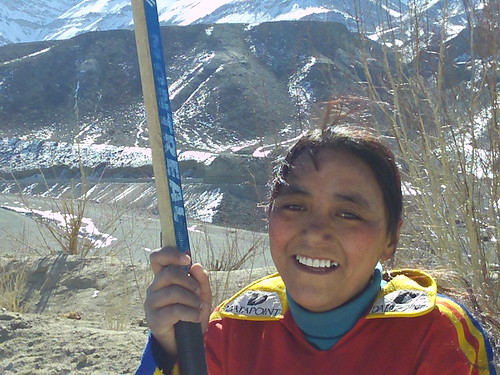
At the end of the 4th National Ice Hockey Championship, I had agreed to train the selected players that were to participate in the 2009 IIHF Asia Challenge Tournament, being held in Abu Dhabi, United Arab Emirates, in mid-March. I had already been familiar with the players after watching them play in the National Tournament, and my scouting report was provided to Akshay Kumar of the Ice Hockey Association of India for his selection committee meeting. I had been watching these players for a solid week, and knew that there was a passion, and a potential to vastly improve. If only for three days before my departure back to Delhi (and around India) I was given the opportunity to lay the foundation of an international style of hockey.

Although I had spent a lot of time talking to the members of the Ladakh Winter Sports Club about my departure date, and my desire to train the team, it was incredibly last minute when I was notified we'd begin training just a few hours later in the day.

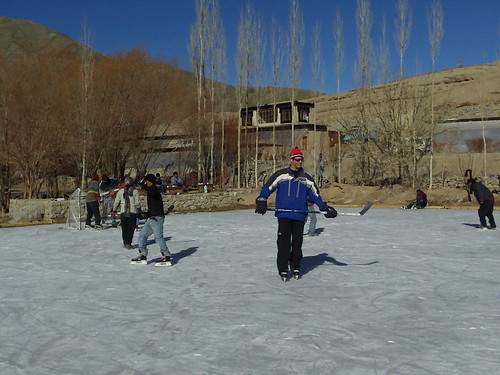
Our first session was scheduled at 4pm, the same day I had begun my intensive training at SECMOL in the morning, and classroom instruction in the evening. SECMOL is 20 km outside of Leh in one direction, and this rink is about 10 km outside of Leh in the other direction. As a result, a ride was arranged on day one to bring me to SECMOL to get my equipment, to the rink, and later back to SECMOL. The rink was on the banks of a river, although I'm not sure if it was the Indus or the Sindhu, and was the practice rink for one of the military teams. In order to make it to the rink, you had climb over a stone wall, and then navigate down AND up some rocky dirt paths. The players' bench - and I use that term very liberally - was a couple of boulders and trees, although most people just got changed on the ice immediately outside of the rink.

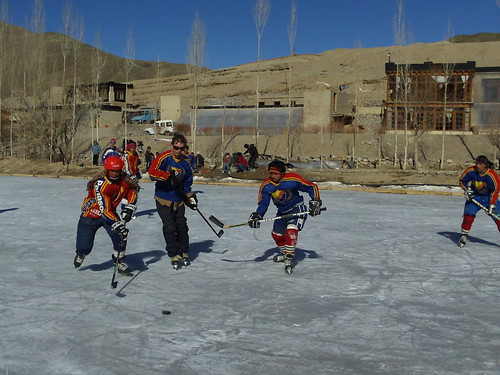
The team was comprised of about 12 players from the military teams, and the remaining roster was filled by players from the local teams, two being from SECMOL (including "formerly selfish"). 6 players were placed on reserve. A couple of players were in Jammu, the winter capital of Jammu & Kashmir, studying in school, and were not able to attend. Only a couple others were also absent.


The surface was brutal. There were speed bumps all over the rink, and they were damn effective, because very often people would come to a complete halt and face-plant into the rink. I speak from experience. On day one of training, I fell four times, twice without my gloves, which are relatively imperative to alleviating the impact of falls. No matter, I had the team (sans a few players – including those from SECMOL that were unaware they had made the team and that there was even a practice that) work on skating drills – in particular, their stopping, cross-overs and backwards skating.

Pond hockey has a yin-yang relationship. Using this analogy, there's a "good" and an "evil". On the side of the good guys, you have freedom: free ice, freedom to play how you like, freedom to have fun. This is obviously great for harnessing passion, and learning how to have fun in the game. You play because you love it and you can. On the (New Jersey) Devil(s) side, you have a pond, with no boards, uneven surfaces, the risk of falling in, and no rules. You lose pucks twice as fast as you would in an arena (pucks are like socks…even when you know the full schedule of where your socks have been, somehow you lose them all the time. Same thing with pucks…even in an arena, you shoot pucks out of the rink and tend to lose them regularly), and the risks of playing on an unreliable surface, with no rules, no referees and no support has not only life-impacting ramifications, but more importantly, it can stunt your hockey growth!

Playing hockey in an arena may be expensive, limited in time, restrictive in its rules and the way it's played, etc, but at the end of the day hockey is played in an arena. Nothing can replace that training.


Long story short, the pond severely handicapped the Ladakhi ability to power skate. As you have learned in earlier posts (you better have read each one!), ice conditions can sometimes be like skating on broken glass, or in this case, with the speedbumps. These hindrances affect the natural skating style, forcing players to skate timidly and focus on their feet. Obviously hockey is a sport that runs on an alternative mode of transportation (has anyone researched ice skating as a source for alternative energy?), but the skating must become second-nature so players can focus on the game going on around them. Being a mediocre ice skater will end up getting you injured, as you tend to spend more time looking down and can get your ass handed to you in one of those moments. Needless to say, nobody wants to see that happen. Neither do I, but there is no alternative in India currently. Outdoor pond hockey is the only way to go. So we fought through the detours and continued training.

After our skating drills, we got into shooting. Immediately I set out to change the mind-set when the players took a shot. I put a moratorium on slap shots until a wrist shot not only became second nature, but became adequate enough to score on a comatose goalie. If you know an obsessive hockey player, and I'm no exception, then you know that they are very emotional and protective about their sticks. The hockey stick is an extension of the body, and it must operate as such. A player should take the utmost care of their stick, because mistreatment can result in breakage on the ice in the middle of a game, always when you're about to take an important shot. Karmic retribution.

After 20 minutes or so of continuous shooting, we got into face-off alignment. In an attempt to radically change hockey in Ladakh, I showed every player specifically where they needed to be on a face-off at each dot on the rink. Once the centers got to see their wingers lined up properly next to them, and their defensemen behind them, they quickly understood the logic of trying to win the puck backwards on a face-off. Mission accomplished! (Hey, I'll take it…beggars can't be choosers).

After the on-ice training, I had the army drop me off at SECMOL so I could teach my off-ice hockey class (see previous post).

Day 2 began mid-day this time, instead of 4pm in an attempt to get better ice. The army players picked me and the two SECMOL players up from campus, and brought us to the rink on the opposite side of Leh. Although we tried to outsmart the weather, we failed. If anyone spent too much time in one particular spot for too long, they'd find that there skate was an inch into the ice, and partially submerged in water. Skating drills? I think not. As a result, more time was spent shooting from different angles quickly to train the goalies to move laterally in the net, play their angles, and practice going down and getting back up.

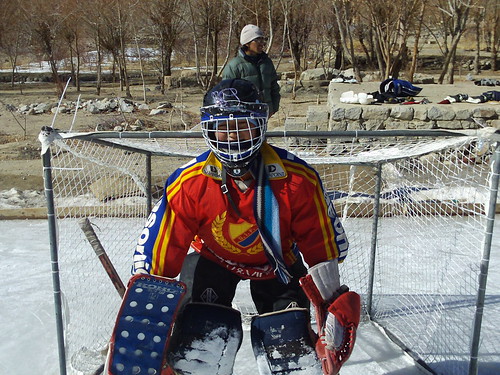
Needless to say, without formal training for the players, there was no formal training for the goalies. The butterfly (a particular style of goaltending that relies upon speed and flexibility in covering as much of the net as possible, while covering your angles) was completely foreign to them. Not being a goalie, I tried my best to explain what a butterfly position looks like and why it's effective. The trouble is that with no equipment and average flexibility (on a good day, after yoga and a massage), I can't get into a butterfly position. I thought I was going to tear my groin. It was worth the sacrifice though, if I could at least make a slight improvement in their abilities in net, especially since my groin is out of commission while in India as it is (too much information?).

After shooting for a solid 35 minutes, we worked on screens and deflections, something they have never utilized. I wanted to lay the foundations of how to position oneself in front of the end and cause absolute chaos. As a center, I got more pleasure in helping a teammate score a goal due to my screening the goalie than when I scored the goals myself. Sure, you take a few shots to the spine or calf, but even that is part of the fun. We ran a drill for the full team where all players would fight for positioning in front of the net, and either I or a defenseman would shoot at the perfect moment for a screen, deflection or rebound. Some did this perfectly and stood their ground in front, others did it perfectly by clearing their man in front, and others took themselves 8 or 9 feet out of position in an attempt to get open. Obviously since this is a drill to fight for positioning in front of the net, they failed.

For day 3, my final day with the team before my departure to Delhi, we decided to hold a morning practice. 9am. This effectively meant I couldn't coach the SECMOL group that night, something I wasn't happy about, but in the grand scheme of things, training this newly formed Indian team is obviously an honor and incredibly important.

The ice was a bit better, although still nothing to rave about, so skating drills returned. After some brief shooting, passing and stick-handling drills, we got into the real meat. We started with a 2-on-0 drill. If it sounds simple, it is. For those of you that don't play hockey, here's the brief-over: two players start from opposing corners on the same side of the ice and leave the zone, criss-crossing as they return back into the zone. They make a short pass as they approach each other, with the player receiving the puck crossing in front of the player passing the puck. Other than the obvious reason for doing this, not running into each other, the logic behind this is that you want the player with the puck to enter the offensive zone immediately so as to not go off-sides. Granted, this is a drill that requires players to go back into the zone they started from; a situation that is unrealistic in a game, but it reinforces the concept of pass and go behind, and stay onsides. Also, it's hockey. You never know where the puck will take you on the ice. Sometimes you skate laterally. In that case, this drill is perfect practice.

It should still sound like an easy drill. Apparently not for Ladakhis. The players consistently failed to pass properly, and to make matters worse, they were going off-sides and running into each other! Communicate! I tried to reinforce that the drill isn't about skating to the top of the zone and just giving the player the puck. You can pass as much as you want before and after, but make sure that you pass at the top of the zone about 10 feet from each other. We attempted this drill for about 30 minutes, and would've done it longer until we consistently got it right, but the tea was getting cold. So we took a break.

When tea time was over, I really complicated things by making it a 2-on-1 drill. Now the defenseman would start near the net and pass to one of the players leaving the zone, then they'd criss-cross, just as before, and come back into the zone against the defenseman. Although it was filled with countless mistakes, mostly going off-sides or making an ill-advised pass, they managed to run this drill more efficiently than when there was no defensive opponent. Go figure.


Other than day three's tea break, there were no water breaks throughout these two-hour long practices. It's not that I was overworking or punishing them, quite the opposite. I felt that with the level of drills we were running, and the limited time available, there was no point in wasting a water break when everyone appeared fresh. But maybe that was just their cultural tendency of respecting authority that kicked in. Either way, being the last practice, I didn't want to leave without getting into some sort of team situation.

I attempted to introduce a 3-on-2 drill that would develop multiple skills at once: defensive pair passing to one another, offensive players coming back into the zone, all 5 players breaking out in unison, the forwards coming in on attack with a 1-man advantage, hence 3-on-2. Before I could really get this drill up and running, we ended practice. Time had run out, and this drill would require another hour that was unavailable.


For now, my training with the Indian hockey team had come to an end. They needed to be ready to play for the Asia Challenge Cup, and I was leaving Ladakh with a strong feeling that more training was imperative.

We needed to work on skating, shooting, passing and positioning. Minor details in a game reliant upon skating, shooting, passing and positioning. Or as they say in Miracle: "Pass, shoot, score." But hey…we have passion! Hopefully we can work on some of these things before time runs out.

Wednesday, February 18, 2009

Words of Wisdom & the Importance of Karma

"Karma"


In case it wasn't obvious already, my previous post was a bit more personal and philosophical than its predecessors. I had toiled over whether or not I should remove/edit this post many times, and after a handful of discussions, analysis, and reflection, decided to leave what I wrote as is.

This blog is a reflection of me in the moment, and this project is as much about the people I am sharing happiness through hockey with, as it is a journey of self discovery, reflection (there's that word again), and confidence.

With that in mind, I wanted to share with you a few quotes that have been incredibly important and helpful to me throughout this journey (and prior), as well as the story behind the inspiration.

"Dost thou love life? Then do not squander tim, for that's the stuff life is made of."
- Benjamin Franklin

  • Benjamin Franklin has been a long-time hero of mine - someone I consider the quintessential American (I wrote a paper on this topic in college). I stumbled across this quote not long after departure from NYI, at a time when I was looking for inspiration and motivation. Along comes a quote from one of the most important men in US history (if not world history) that promotes making the most of your time and working hard, and it immediately motivated me to get to work and not let the comforts of normalcy get in the way of opportunities of the present and the future. This quote is pure Carpe Diem - sieze the moment - and doesn't conflict with the philosophy of karma. In fact, it works side by side, and in my opinion, it says that our fate lies in our determination, focus and intention. If all of those are positive, good things will come, and what can be more karmic than that!?

Ikigai: That which makes one's life worth living
- Japanese word/philosophy
  • I am still trying to figure out where I saw this word and it's translation. What I can tell you is that in the research I've done, there is a true sense of "Ikigai" in Japan, but there is also a fascination with it. Studies have been conducted on whether ikigai is a major motivation in Japanese (and other) culture - but I didn't read the results, because quite honestly, I don't care. For me, ikigai absolutely rang true and vibrated through my soul. When I talk about passion, my impression and opinion is that it is similar to what the Japanese consider ikigai. Passion is pursuing and enjoying that which makes one's life worth living, and hockey is that passion for me (as you well know by now). It was just one more karmic indicator that I was shooting at the right net.
(side story: I was playing in a men's league game about 1.5 years ago, and had joked with my new goalie earlier in the season that I have a tendency of deflecting shots towards my own net when I'm playing defense...not intentionally, of course. We were teasing him and saying that at some point in the season I would score on him - not realizing that this would happen. In that game, the goalie passed the puck me on the boards in the defensive zone, and I was facing the goal line on my end of the ice. For some odd reason, I felt I needed to get rid of the puck quickly, and tried to shoot it behind the net, around the boards. I missed. My target, that is. Because I shot the puck into my own net from 15-20 feet away, as the goalie was skating back to his crease. Confused, I slammed my head (in a helmet) against the boards, trying to figure out what I was trying to accomplish and why it went so wrong. We won the game by a lot, and it's only men's league, so in the end, who cares? But my prophecy came true - which is an indicator of "The Secret", something that also ties into karma. I scored on my goalie, as blatantly as if I was on the opposing team!)

Continuing on...

"When you are inspired by some great purpose, some extraordinary project, all your thought break their bonds; your mind transcends limitations, your consciousness expands in every direction, and you find yourself in a new, great and wonderful world. Dormany forces, faculties and talents become alive, and you discover yourself to be a greater person by far than you ever dreamed yourself to be."
- Patanjali (Ancient Indian organizer of Yoga Sutras & Philosopher)
  • This quote floored me! For some time, I had been preaching about passion and idealism, and then I stumbled across this quote - while in Delhi. The office that I spend a lot of time at in Delhi is next to Patel Chowk Metro Station in Central Delhi, the station that houses the Metro Museum. On my first day, I walked through this exhibit briefly, and figured I had seen everything that needed to be seen just by passing it. A few days later, I made plans to meet a friend in the station, and ended up waiting for about an hour inside the station. So I decided to really take in the full details of the Delhi Metro. Around 40 minutes in, I stumble across this quote, which had been used to motivate the developers/construction workers/employees of the system. It felt as if it was written for me! In just one paragraph, written at some point in the past by and Indian I had never heard of, the human condition - my condition - was on display for all to see. For me, "The Hockey Volunteer" is my extraordinary project. It is my calling. We all have that in us, and when we find it, everything changes. Our lives change. We become focused, determined, resourceful, energized, and ultimately: happy. Talk about karma!
Back to relevant updates shortly.

Until then, make sure you check out pictures of hockey in Ladakh (and tourism in India, if you're so inclined). I have also posted new pictures on Flickr taken by others in Ladakh, including some pictures by Russ Taylor (nomadruss.com). Please check them all out. Don't forget Akshay Kumar's pictures from the 4th National Ice Hockey Tournament.

Saturday, February 14, 2009

Ice Hockey in Ladakh, Part 6: Coaching at SECMOL/Founding “The Hockey Volunteer”


You may or may not know, but my original motivation for coming all the way to Ladakh for hockey was to work with the students at SECMOL (Students' Educational and Cultural Movement of Ladakh). This had come about after a random email sent my way from my friend and former colleague Angela Ruggiero of Team U.S.A. Hockey involved SECMOL, and I decided to research a bit what it was about. The more I read, the more I was compelled to help.

SECMOL is a non-profit that has a campus about 20km outside of Leh, in the middle of a mountainous desert, on a cliff overlooking the Indus River. It is in an absolutely gorgeous scene. These days, SECMOL exists to provide children from around Ladakh, mostly those from less fortunate families (in an area that is already very humble compared to life in the West – "Things we take for granted…"), and provides them with a rounded education, teaches them practical responsibilities, and allows more than enough opportunity for fun and constructive interpersonal interaction.

Throughout the year, high school students from VIS (Vermont Intercultural Semesters) come to Ladakh and spend some time at SECMOL teaching the students English, working on school-work for credit, and providing the SECMOL students and staff with an opportunity to learn about life and culture in America – in particular, Vermont.

The campus is solar powered, and after a handful of ventures into educational services, liberal magazine printing, and childrens' books, solar paneling is among the few remaining business that allows SECMOL to make revenue independent of donations and the fees collected from students and volunteers. On their website, there was a request for a hockey coach, and like a slap shot to the temple, I was overtaken with a swelling of emotion by the calling that had come out of nowhere, or had it?

Around the world, there are handfuls of people that believe in fate, or the edict that "things happen for a reason", and others in the philosophy of karma – that what we do has a direct impact on what happens to us (simply: cause and effect). For many, The Secret was powerful source of inspiration to really focus on our dreams. Malcolm Gladwell would argue that it's the situation unto which we were afforded in life, mixed with a fair degree of randomness, hard-work, and luck, that lead to our outcome in life. Others take the "more practical" route that we make our own opportunities, and that randomness has nothing over good 'ol sweat, blood and tears.

For some time now, many of these philosophies have resonated for me, some of them conflicting or harmonizing with each other, and when my tenure with the Islanders ended, I knew that the time to test my character and put my dreams into motion had arrived. All of my life's experiences to that point had provided me with a foundation to grow upon, and when this email came my way from Angela, I had already identified many of the things important to me to live a happy life: traveling, playing hockey, drinking tea, doing good for others/generating good karma, meeting interesting people, forming lasting connections/friendships, never working a "9-to-5" again, being my own boss, finding a path to enlightenment (seriously). These are things I consider passions that define me, some are simple, some are complex, but all are important. With the pursuit of passion, there is still a business plan, and a desire to make money, but never the motivation to put money before happiness. The opportunity to travel to Ladakh, a Buddhist (Buddhism is based upon compassion, doing good for others, and the pursuit of enlightenment) region in the Himalayas of India, one of the world's most unique countries, where ice forms naturally and hockey is played with passion, where I could drink endless amounts of tea, and do things the way I feel are important in life and in business was too much to resist. This email regarding SECMOL opened my eyes and provided me with the path to follow through on my pursuit of happiness, and so became "The Hockey Volunteer" initiative.

In my first day of emails with SECMOL, on December 8, 2008, I had enquired into how much my trip would cost, and promised that I would make it to Ladakh the moment I had raised the appropriate funds. The cost to make it to India and survive for 1 month on meager conditions was $2000. The cost to stay longer and still live pretty modest, $3000. If I was to bring hockey equipment, $4000. My goal was to raise the money before the ball dropped and 2008 had ended, and I set out on utilizing the digital world as my primary resource for fundraising. Being a card-holding member of Generation Y, and someone that has always been keen on utilizing computers and new technology, this was something I had a passion for, and had experience with when I could say "I'm Adam Sherlip, and I'm an 'Islander'". Unknown to everyone, up until now, is that I vowed to myself that I would plaster the internet with this program for the sheer point of proving that it could be done, and that technology could be used to make a difference in peoples' lives if we truly allow it. I was never given the opportunity to utilize new media/digital marketing the way I wanted previously, and this was my opportunity to prove my old bosses wrong. I wouldn't call it vengeance, or anything of similar harshness, but rather the opportunity to prove to myself and to those that had doubted my expertise and/or idealism that both could succeed, simultaneously.

Now at this point, you may be thinking this is about ego, and I want to vow to you that my only boost in ego is when I see the difference I have made in the lives of countless people to date, using hockey as my tool. That's it. I feel good, when I've done good*. The rest is fluff. Yes, it's important to have motivation. Yes, it's important to have dreams and goals. But none of that compares to knowing that your services are not only needed, but they are requested and appreciated.

On January 12, 2009, just over 1 month from deciding the path my life would take herein, I departed for Ladakh, by way of Frankfurt, Germany and Delhi, India. I differentiate between Delhi, India and Ladakh because this is truly a world unto itself. During the Winter, Ladakh is cut off from the rest of the world, including it's neighboring regions: Zanskar, Jammu and Kashmir (the name of the state). With me on this initial voyage was a bundle of 14 hockey sticks, 2 pairs of skates, some pucks, my gloves, and 2 sets of netting. I was told that lefty sticks were called "righty" and righty sticks were called "lefty", and that what I know as lefty sticks was in high demand. As a result, I brought a half-dozen of my old lefty sticks, and received donations of another half-dozen sticks from a local Play it Again Sports on Long Island, of which only 3 were righty, and two of those were for children. Originally, my plan was to receive a donation or purchase two sets of hockey goals that came with large backstop-netting, so that wide shots would stay in the rink. In the meantime, I had discussed with SECMOL the proper size of the nets, and when they notified me they had welded some pipe to regulation size, I was able to purchase netting to line the pipes. The morning of my departure, I rushed out to a sporting goods store the moment they opened, and purchased lacrosse-style netting, against the recommendation of the people in the store. I then went into the neighboring hardware store and purchased 1 large bag of industrial strength ties.

Both pairs of skates were mine from the past, and along with the rest of my equipment, the plan was to leave everything behind. It's very Buddhist not to hold on to possessions, and since everything is replaceable for me, and difficult to get for the Ladakhis, it seemed like the best option. That, and I would be able to lighten my load for when I began my travel around India.

As you know from my first post here in Ladakh, my child-like tendencies took over and I had jumped onto the rink within a couple of hours of arriving, stupidly taunting the altitude to prove that it could debilitate me. Prior to the headache that REALLY felt like a slap-shot to the temple, I was told that the sticks I called lefty are also called lefty in Ladakh (shocker, I know), and that they had actually needed righty sticks, as over 90% of the players shoot from the right side. Damn.

In that first session on the ice, the mid-level players, many female, were on the ice playing around with one of the instructors from Vermont. She quickly deferred to me, and I showed everyone how to take a proper wrist shot (naturally, I missed the net on one of my first attempts, but no matter), and then worked on some puck-handling drills before getting into a scrimmage. This was my only lesson for the better part of two weeks.

The oldest boys' team was participating in a local tournament, the same tournament I identified as having a SECMOL player dominating his competition on selfish play, and while they were competing in the late rounds of the tournament, the rest of us traveled to the opposite side of Ladakh to participate in a tournament in Chiktan/Kargil, co-sponsored by SECMOL. At this point, I was made aware that there was more tournament play upcoming when we returned to the Leh area (the capital of Ladakh), and that many of the top players would be involved in that tournament too. We agreed that my instruction should begin after the tournament ended. The only other interaction with hockey at SECMOL was in the scrimmage we organized between our American team and the top boys' team, in which we absolutely demolished our better conditioned/acclimated opponents on the backs of our superior passing (and speed and shot accuracy). As we played out our drubbing, I made a point to call out the selfish play of the "all-star", and noticed his game (along with the rest of his teammates) morphing into a cone-like strategy of stand and wait for the puck to come.


Again, based on earlier posts, you know that the tournament I speak of was the national tournament, and I had become heavily involved in everything around this event, including the drama, unfortunately. In the middle of the national tournament, was the Canadian tournament, and when all was said and done, 7-8 days were devoted to these two conjoined hockey happenings. During this period, I was practically unseen at SECMOL, waking up early to head into Leh, staying in town all day, and returning late at night, if I returned at all. Although we had discussed that my lessons would begin when all of this ended, I was starting to feel like a man who wasn't living up to his word. I had come to Leh for SECMOL, and was seen dealing with an organization that has had strained relations with the embattled NGO: the Ladakh Winter Sports Club.

I had to be repeatedly reminded by my friend Henk that I was in Ladakh for hockey, and based on my discussions with SECMOL and my contribution to the rest of Ladakhi hockey, I was upholding my initial goal: to share happiness one puck at a time. Phew, I was getting worried.

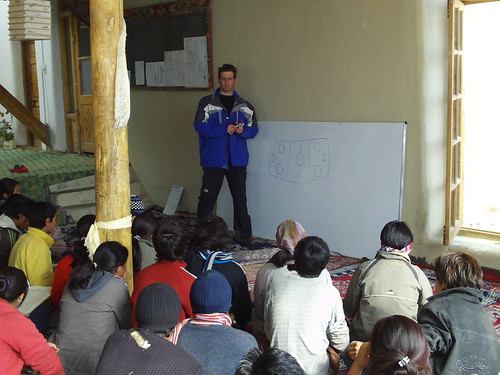
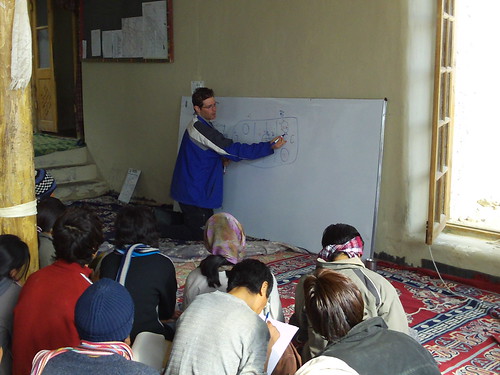
As the tournament was winding down, I organized an off-ice hockey class at SECMOL to go over the basics of hockey. Just like with the local referees, this class was focused on discussing penalties, off-sides, and icing. The group was engaged for an hour, working through my English, a translator, and "Slap Shot"-like demonstrations of how to commit the penalties, as well as the signals for them.

At the same time, I began working with the most advanced players from SECMOL in private sessions (which ended up quickly becoming public, because many of the other students would force their way in), including the player previously identified as selfish. He had performed relatively miserably in his earliest matches in the national tournament, and I attempted to reinforce what constitutes quality hockey in North America. Our time together wasn't as productive as I would have liked, as he had a hard time understanding the concept of a snap-shot (something I didn't want to get into, but one of the Vermont students had introduced it), as well as how to break out of the defensive zone and find the puck. People used to say that Wayne Gretzky would always "have the puck find his stick", but in reality that means that Gretzky was smart enough to understand where the puck was going, and make sure he was there. These were the things I was trying to teach him, as well as how to make close passes while moving in all directions.

The conditions of the ice at this point in the training was less than forgiving, and at one point I caught my skate in a deep rut, and fell backwards on my lower back, an area I severely injured in a hockey when I was a teenager, that gets easily aggravated and affects all movement in my body when it flares up. Fortunately, this pain subsided quickly, and without any intense spasms.

When the tournament ended, I was able to really get to work with the SECMOL players. In the late afternoons, as the sun was setting, I dragged "formerly selfish" out onto the ice, along with a few of his teammates, and we worked on honing some of the intermediate skills, like deflections and breakouts. In the mornings (yes, I'm going backwards), I spent a couple of days instructing the less advanced groups, working on passing, skating (in particular, backwards), shooting, and 2-on-1 drills. In the evening, we went back into the classroom for a few more lessons. You already know day one. Day two discussed face-off positioning, and day three was about zone-play, including break-outs. Afterwards, I gave the group an overview of the NHL, including listing all of the teams and showing where they were on the map. To my disappointment, these so-called hockey fanatics knew nothing about the NHL, or about North American geography. To my further disappointment, I forgot one NHL team, and not until 4 days later did I remember which team I had left off out of the hockey geography lesson: sorry Colorado Avalanche fans!

All of this training with the players at SECMOL was in my final scheduled days in Ladakh, but as you will soon find out, this intense period of hockey overload and instruction at SECMOL was only a sliver of what was going on.

It only gets better!


*I have made a conscious decision to ignore the foundations of proper grammar here, and use "good" instead of "well". I think the term "I've done good" is much more representative of something that feels inherently decent and morally right, whereas "I've done well" seems mediocre and impersonal.

Friday, February 13, 2009

Ice Hockey in Ladakh, Part 5: The Red Coats are coming! Er, uh, I mean the Canadians are coming!


This posting is in conformity with the rest of this blog, but the post is easily modifiable for a newspaper article. Pictures will not be posted to this article until at least February 19, due to poor internet in Ladakh. In the meantime, you can check out pictures on my Flickr account: Anyway...enjoy...

In my apparent ego-centrism, narcissism and ignorance, I wrongly assumed that I was the Christopher Columbus of ice hockey in Ladakh. “I have discovered hockey in Ladakh,” I said to myself in my head, but like Columbus in regards to America, many had come before me. Obviously, hockey was being played in Ladakh, and has been for some time. It became logical, seeing as all you needed was some ice and hockey equipment. People that came here for hockey over the years brought it with them, which solved that riddle.

So many sports stories begin with who beat whom and which player performed the best. We hear about the rivalry of sports and see the behavior of fans as crude, ignorant or violent. But what gets lost in the shuffle is how sports can bring people together.

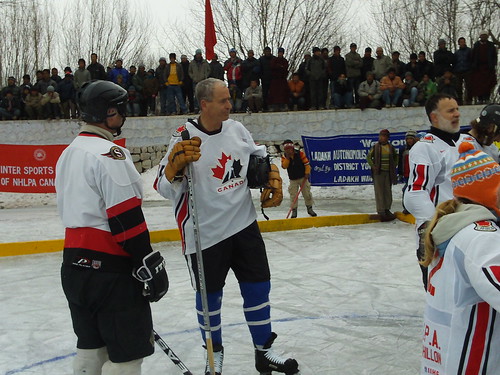
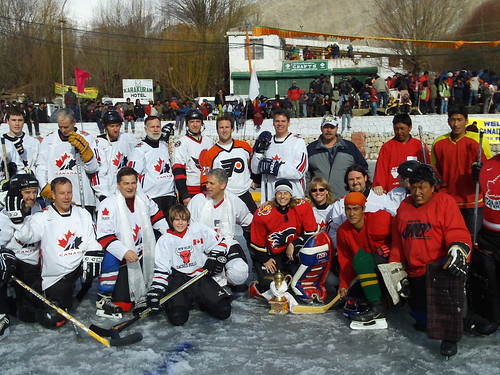
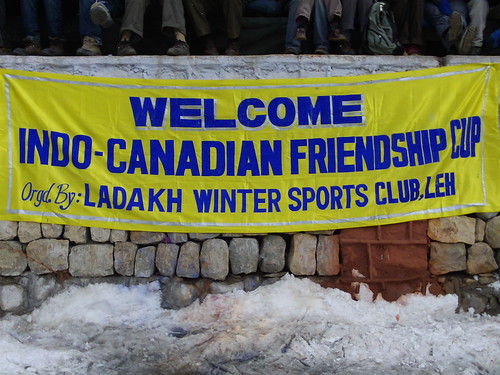
For almost a decade now, members of the Canadian High Commission (Embassy) in Delhi have been coming up to Leh, Ladakh in the Indian state of Jammu and Kashmir. They have been participating in a friendly tournament, the Indo-Canadian Friendship Cup, with local hockey teams, and have been bonding over the sport of ice hockey in the only region in India where ice forms naturally.

This was news to me. At the onset of the 4th National Ice Hockey Tournament, I was informed that a team of Canadians was coming. I had seen a sign around the rink thanking the NHLPA for their support of Ladakhi hockey, but was completely stunned to learn that a bunch of players would come up from Delhi when it’s a beautiful 70°F (approx 23°C), year in and year out, tough out altitude sickness, and share their happiness as well!

Furthermore, the national tournament stopped. Completely. Play would resume once the Canadian team left.

Tony Kretzschmar, who used to work for an engineering company in Delhi, has been participating in the tournament since its inception. He now works in Shanghai, but set aside time in his schedule every year to visit one of the most remote regions in the world.

For your benefit, here is a full quote from Tony:

"I have had the distinct privilege of seeing the game of hockey develop in Leh since 2001. When I think back to the way they use to play back then, using field hockey sticks, old rusty skates, very little equipment, and even less understanding of the rules of the game, I feel a great sense of pride in seeing the teams play today. The progress has been heartwarming, and it was nice to see the games against Canadian teams not only resulting in Canadian domination...they actually beat us a few times in the championship over the years. However the goal of our annual Canadian team visits is not to win, it's more about hockey diplomacy and developing the game for the benefit of the children. The social aspect has grown out of what started out as a high adventure pure sporting initiative. I must say this is truly what brings me back and drives me to work on connecting the many folks around the world who want to help."

The games are always close in these competitions. The Canadian (and a few American) players don’t have much opportunity to play hockey while stationed in India, and their brief trip into an altitude of nearly 12,000 feet (about twice that of Denver, or three times that of Calgary) make it nearly impossible for the players to over-exert themselves. Air is thin, and breath becomes short.

Manitoba native Casey Guenther, a teacher at Woodstock International School in a relatively nearby state of Uttarakhand (nothing is nearby Ladakh in the Winter), was one of the top players on the Canadian team. He and his wife had visited Leh in the Summer of 2008 and “…fell in love with the place, but it’s the first time [coming here] in Winter.” A tall, lean player who looked to be in good shape, Casey, like so many others, had a hard time with the altitude. “Besides not being able to breath, it’s good. [My coming back now. It’s great. Hard to breath, but it’s fun.”

Over the years, the relationship between the Canadian High Commission team - only partially comprised of High Commission staff - has intensified. Each year, the team has donated equipment, and has increased awareness in Canada that has resulted in more equipment and resources to the Ladakh Winter Sports Club, including a skate sharpener, although I was informed that it took years to get this up and running, as it was a 110V North American style plug, and the converter needed was in Delhi. For a long time, nobody ever bothered to purchase it and bring it back to Leh.

Ego aside, I was delighted to hear about the Canadian team coming, and I made it a priority to meet the folks involved and get some good pictures, video and interviews. As usual, I quickly got absorbed into everything, and had met one of the members of the High Commission prior to the full team arriving and we had a nice chat over lunch. Once the tournament had begun, I made it over to the rink and struck up some conversation with family members of the team. They informed me that this was far and away the largest group to come up for the tournament, 47 – most being family & friends of the team.

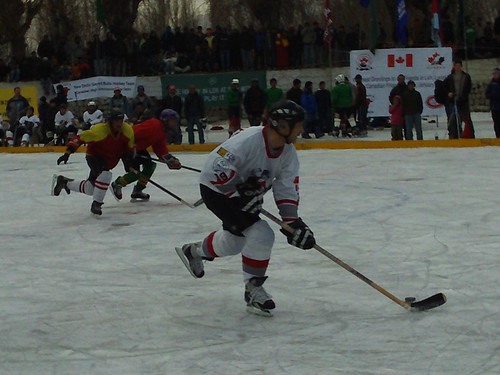
The fans are active participants in these games. The crowd, expectant of fun hockey matches, was large and loud. No matter which team was with the puck, a deep roar would sweep the sunken, stone-lined rink whenever a top player on either team would touch the puck. Envision Alex Ovechkin on a shorthanded breakaway with 1 minute left in the 3rd period, in a tied playoff game 7.

Although many of them were admittedly out of shape, and all of them were having difficulty breathing, the High Commission team was able to hold off the J&K teams in consecutive competitions on Day 1, a Saturday. This was when I got most of my interviews with the team, and a handful of their players, including, Ken Macartney, the Deputy High Commissioner. “This is my third year in Ladakh,” said Ken, “and it’s fantastic…one of the most beautiful rinks in the world.” For Ken, it brought back nostalgic sentiments. “It’s a reminder of small town Canada. It’s a great experience and we look forward to it at the High Commission and in the [participating] Canadian community.”

The temperature had become increasingly warm during the days of these matches this year, with mid-day temperatures reaching about 1-2°C/33-35°F. As you know from your science classes from the days when you received some variety of education, ice melts at 0°C/32°F. The same is true at high altitude, where the sun shining down on a pond that continues to receive running water and is surrounded by heat-absorbing rocks brings the temperature above freezing. As the ice gets cut up in these conditions, it becomes increasingly dangerous. This is similar to what our American team dealt with in Kargil (Ice Hockey in Ladakh, Part 2 - Kargil Tournament).

Just like when the Chief Minister of Jammu and Kashmir attended the finals of the 4th National Ice Hockey Tournament, the Karzoo Ice Rink just a quarter mile away from the Main Bazaar (Main Street) of Leh began to sink under the weight of 2-3 times the normal capacity. Often times, a whole group of people had to pick up all of their gear and belongings, and shuffle off to a different portion of the rink. That is, until that section started to sink.

Last year, it was quite the opposite. Depending on your point of view, the weather was either great for hockey, or way too cold for civilization. Canadian goalie Sarah Finall, an employee of the Canadian High Commission, participated in her first tournament last year upon her posting to Delhi. According to Sarah, “this whole experience is fabulous, even though it was minus 30°C (about -25°F) last year and I nearly died!” Her sentiment regarding the experience of hockey in Leh and the hospitality of the Ladakhis was consistent throughout the group. “It’s something you don’t want to miss,” stated Sarah, “it’s so amazing. The Ladakhi people are so great and welcoming.” The altitude was just part of the experience for Sarah, “What an experience to come up and play hockey at this altitude!”

Rumor had come my way that there would be a banquet at the “Only star hotel in Ladakh” (think about that for a second), and while I had assumed that I would be able to attend that event, I was never given a formal invite, so a local friend, Henk Thoma (no, he’s not Ladakhi…he’s a Dutch transplant that I’ll tell you about in a future post) and I went back to SECMOL and watched their “State of the Campus” address. Each student was responsible for a particular responsibility at SECMOL, including management of the library, collecting money, ice-rink maintenance, and milking the cows. The judges of their presentations critiqued their poor presentation skills, and although most of what I said was under my breath to Henk, I was very disappointed when the winning presentation had endless typos and poor grammar. Especially since one of the presenters was a European that was there teaching English. Nonetheless, afterwards, the group got to relax and get to one of their favorite activities: singing along with Ladakhi music and dancing in a way reminiscent of MTV's, “The Grind”, circa 1994.

The next day, the final match between the Canadians and an All-Star J&K team commenced. But due to continued poor weather (in hockey terms), the game was called at the end of the second period with a tie-game. The fans in attendance were disappointed at the outcome, but when safety is concerned, I err on the side of being conservative (well, sometimes I do), and after a few injuries sustained to the players on the Canadian team, they felt it was in the best interest of self-preservation to stop the game.

After the game, I went into the office where the Ladakh Winter Sports Club camps out, and on one of the tables was my formal invitation to the banquet that was held the night before. As I spoke to the LWSC members during the day, they had asked why I wasn’t in attendance. “I didn’t know I was invited,” I replied. One of them told me that when he saw me walking in the Main Bazaar, he assumed I was heading to the hotel, even though they apparently had a car to take me. Oh well. That evening, it was more than made up for, and entirely on accident.

The previous week, when Akshay Kumar of the Ice Hockey Association of India had come to Leh, Henk and I met him at the same hotel for dinner, and we were both very impressed, as we were both accustomed to the traditional amenities of Leh and throughout Ladakh. Granted, I’ve only been here for a handful of weeks, but Henk has been living in Leh for over a decade. We had decided that we were going to treat ourselves to a nice dinner at the hotel and enjoy something different than rice and daal (lentils).

I guess in the back of our minds we knew there was a chance things would play out as they did. Upon our arrival at the hotel, we immediately ran into some of the folks from the Canadian entourage and the Ladakh Winter Sports Club. We were quickly invited into their banquet that was about to begin, and while I’m sure a handful of people were wondering how and when we got ourselves into this dinner, it was an innocent coincidence.

Fortunately, Henk and I already being familiar with the Ladakh Winter Sports Club and my previous interaction with the Canadian group, we easily interacted with everyone at the party. For me, this was one of the most significant and impactful moments of my trip to date. Everybody from this group was incredibly warm and kind-hearted, which immediately cancelled whatever apprehension was in the back of my mind, being a stranger and an American (it’s easy to feel judged on a hockey-level by Canadians). The hockey talk was enlightening!

I heard stories from all different people about the prior support that Ladakh has received in ice hockey, and it’s plenty! The first Canadian team played in Leh in 2001, opening the eyes of the population to the North American style of the game. Within a few years, Canadian press had covered hockey in Ladakh and India in a handful of specials, and a couple from Canada produced an award-winning documentary: “Hockey Night in Ladakh” to showcase the passion for the game in Ladakh.

In 2003, the NHLPA Goals and Dreams Foundation donated 50 sets of equipment to the Ladakh Winter Sports Club. Coaches from New Zealand came in 2004 and spent a month teaching ice hockey and figure skating. In 2005, money was set aside to start the construction of an indoor ice hockey rink in Leh. That rink has yet to break ground, but after this year’s national tournament, the Chief Minister f Jammu & Kashmir pledged twice as much money and vowed that the rink would be completed.

The Los Angeles Kings Junior coach also came in 2005 to coach, the same year a skate sharpener arrived, and the following year the Kings brought a Ladakhi team to Los Angeles. The coach of the team Ladakhi team was initially denied his visa to America, but after some maneuvering was able to get his visa and accompany his team to the States. He never returned to India. He’s somewhere in California, most likely the Los Angeles area, and is married to an American woman.

Beginning in 2007, the Montreal Canadiens have been supporting Health, Inc., a non-profit operating in rural Ladakh. They held coaching clinics in Ladakh, as well as donating equipment.

To find out all of this was overwhelming, but in the best of ways. I could not be more delighted to see how much support has been given to Ladakhis to improve their hockey, but there’s a flip side.

The longer I stay in Ladakh, and the more people I talk to about Ladakh, the more I have learned about the negative aspects of Ladakh. Sure, the people are very welcoming, and I have been treated with nothing but the utmost respect. At the same time, there is a pattern of staggered support - usually one season of coaching or donations - given to a culture that has their palms wide-open, and as a result, very little progress has been made. For nearly a decade now, people with the best of intentions come to Ladakh, fall in love with initial impressions and gorgeous scenery, and do what they can to help the people. The fact of the matter is that Ladakh is an area that receives a disproportional amount of government support because it’s a border territory, so the people need to be kept happy…or at least content. It has a large population that is uneducated and out of work, corruption is prevalent, and because tourism is the staple industry, Westerners are relied upon for their good graces and deep pockets.

At the end of the day, I am not here to fix a culture, nor do I want to. I’m also not blaming anyone, as I have also developed a love for Ladakh. That being said, I DO want to change the hockey culture here. The passion and love of the game that I felt from the Canadian group was as palpable as that of the Ladakhis, and I vowed to all of them that my only goal here is to tap into the passion for the game and help it grow. I voiced my desire to work with the Canadians next year, and hopefully join their team, and I know they are interested in holding their own hockey clinic here next winter, something that would break with a pattern of coming up for a couple of days, playing a few games, throwing some parties, and going back to life in Delhi or abroad.

I would like to see everyone involved in Ladakhi hockey to have a more focused, cooperative plan, this way we don’t take baby steps each winter, and see all of our work done for naught. Instead, with our sustained support, we can take giant leaps year-round. If we work together and strategize, we can do so much more to improve the quality of hockey in Ladakh, like training local coaches to train the local population.

Since my passion is hockey, I would do a disservice to myself, and everyone involved in the sport, if I didn’t share my concern and ideas for how we can share our mutual love for the game. The promising part is that I know everyone I’ve met here feels the same way about the game as I do, and with our mutual passion, anything can be accomplished! I can’t wait to get to work!

Multimedia

Listen to my broadcast from  Saturday, 1/10 with the guys from Hockey Night on Long Island: 
Listen to Hockey Night on Long Island on internet talk radio

Special thanks to the Allan and Rolly at Nasty Hockey Show for being strong advocates for this program, and putting together this broadcast. Please check it out!
Awesome quote from their website: "I’ll match your contributions up to a total of $200. Just leave a comment on this blog with what you have donated."
Thank you guys!
Special thanks to Sarah Elizabeth Foster of www.sarahelizabethfoster.com for doing this interview, supporting the cause, and donating! (NOTE: I mention in the video I'll be leaving by the New Year. My departure date is now set at 1/12/09!)